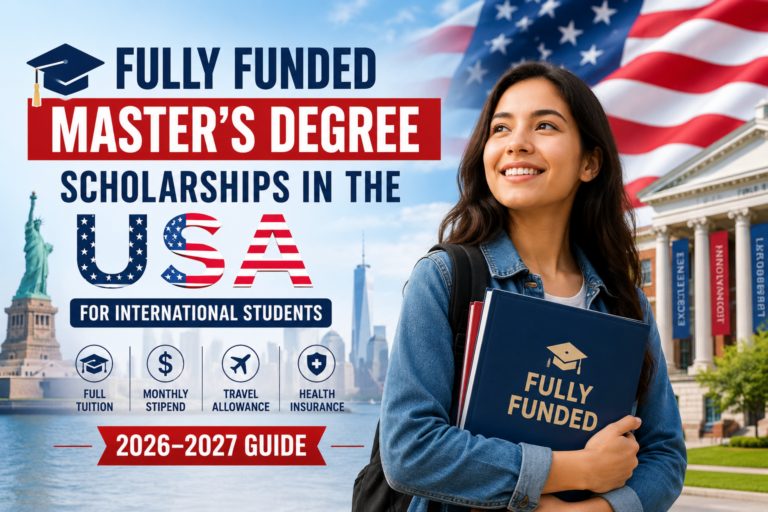
Every year, thousands of ambitious students and young professionals from more than 160 countries pack their curiosity — and not much else — and head to the United States to study, research, and grow, all without paying a cent in tuition. The vehicle behind this is the Fulbright Foreign Student Program, one of the most prestigious and generous international scholarships in the world.
If you’ve ever dreamed of earning a graduate degree in the U.S. but assumed the cost would be out of reach, this program was built with exactly that obstacle in mind.
What Is the Fulbright Foreign Student Program?
The Fulbright Foreign Student Program is a U.S. government-funded initiative, financed by the U.S. Department of State and administered by the Institute of International Education (IIE). It enables graduate students, young professionals, and artists from outside the United States to pursue master’s or doctoral study, or conduct non-degree research, at American universities.
It’s part of the broader Fulbright Program, the U.S. government’s flagship international educational exchange effort, and it operates in more than 160 countries. Roughly 4,000 international students receive Fulbright funding each year, making it one of the largest scholarship programs of its kind.
Beyond just paying for school, Fulbright is built around cultural exchange. The idea is simple but powerful: send capable, curious people abroad to study, live, and share their perspective, and in doing so, build understanding between countries that outlasts any single degree program.
What Does the Scholarship Cover?
This is a fully funded scholarship, and it covers the essentials that usually make studying abroad financially impossible:
- Full tuition at a U.S. university
- A monthly living stipend to cover housing and daily expenses
- Round-trip airfare between your home country and the U.S.
- Comprehensive health insurance for the duration of the program
- Additional funding for research-related costs, such as books, conference travel, or lab work
- J-1 exchange visitor visa sponsorship
On top of the financial support, Fulbright grantees get access to professional development opportunities, leadership workshops, and community engagement projects, plus a built-in network of Fulbright alumni that spans government, academia, and industry worldwide. Many former grantees go on to become heads of state, Nobel laureates, and leaders in their fields — the kind of network that keeps paying off long after graduation.
Who Can Apply?
Eligibility requirements vary somewhat by country, since the program is run locally through Fulbright Commissions and U.S. Embassies, but the general criteria look like this:
- You must be a citizen of a country with an active Fulbright program (this includes most countries worldwide) and cannot hold U.S. citizenship, including dual citizenship
- You need academic credentials equivalent to a U.S. bachelor’s degree, with a strong academic record
- The program is aimed at graduate-level study — undergraduates generally cannot apply
- You’ll need to demonstrate English proficiency, typically a minimum TOEFL score of around 550 (paper-based) or 79–80 (internet-based), or an IELTS score of about 6.5, though exact thresholds vary by country
- You must be residing in your home country at the time you apply
Because Fulbright is decentralized, always check the specific requirements published by the Fulbright Commission or U.S. Embassy in your country — deadlines, required test scores, and even which fields of study are prioritized can differ from one country to the next.
How the Application Process Works
Unlike many scholarships, you don’t apply directly to a U.S. university or to Washington. Instead, applications go through the Fulbright Commission, Foundation, or U.S. Embassy in your home country. From there, one of two placement paths applies:
- IIE-placement: The Institute of International Education places you at a suitable U.S. university and manages the admissions process on your behalf — helpful if you’re not sure which schools to target.
- Self-placement: You research and apply to universities yourself, and manage direct communication with admissions offices, while Fulbright coordinates the scholarship logistics.
A typical application includes academic transcripts, letters of recommendation, a statement of purpose or research/study proposal, and standardized test scores where required (some countries also ask for the GRE). After an initial review, shortlisted candidates are usually interviewed locally before finalists are selected.
Timelines vary significantly by country, so the single most important first step is visiting your national Fulbright Commission or U.S. Embassy website to confirm your country’s exact deadline and document checklist.
Tips for a Strong Application
- Start early. Deadlines are often 9-12 months before the program actually begins, and strong applications take time to develop.
- Get specific in your proposal. Vague goals (“I want to study business in America”) are far less convincing than a clear research question or academic plan tied to your career trajectory.
- Show the “why U.S.” and the “why you.” Selection committees want to see how a U.S. education fits your long-term goals, and how your presence would add something to the classroom and community you’re joining.
- Invest in your recommendation letters. Choose recommenders who know your work well enough to speak to specifics, not just your grades.
- Lean on your local Fulbright office. Many run info sessions, sample application reviews, and alumni panels — free resources that can meaningfully sharpen your application.
Why It’s Worth the Effort
The Fulbright Foreign Student Program is competitive by design, and that’s precisely what makes it valuable: a Fulbright grant carries real weight on a CV, and it opens doors — academically, professionally, and personally — well beyond the years you’re actually in the classroom. For students who can’t otherwise afford U.S. tuition, it’s also simply one of the few realistic paths to studying in America without taking on debt.
If a fully funded U.S. graduate education is on your list, the Fulbright Foreign Student Program is worth serious consideration. The best next step is straightforward: find your country’s Fulbright Commission or nearest U.S. Embassy page, note the deadline, and start building your application timeline today.