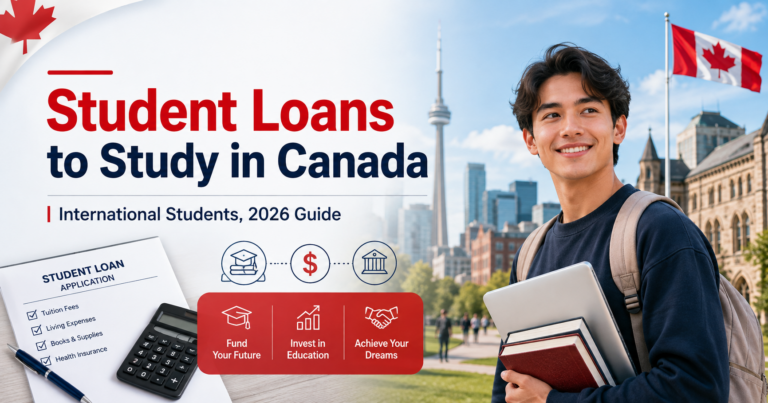
Studying in Canada can cost tens of thousands of dollars per year, especially for international students. Tuition, accommodation, food, health insurance, textbooks and transportation can quickly push your annual expenses beyond what you or your family can comfortably pay.
A student loan can help cover some of these costs. However, getting a student loan as an international student works differently from getting one as a Canadian citizen or permanent resident.
This guide explains how international students can get a student loan to study in Canada in 2026, the available options, eligibility requirements and the steps you should take before borrowing.
Can International Students Get Student Loans in Canada?
Yes. International students can get student loans to study in Canada, but your options are more limited than those available to Canadian citizens and permanent residents.
Most international students are not eligible for Canada’s government student loan programs.
Canada Student Grants and Loans are generally available to:
Canadian citizens
Permanent residents
Protected persons who meet the eligibility requirements
As an international student on a study permit, you will normally need to consider private lenders, Canadian bank credit products, loans from your home country or financial assistance offered through your university.
Student Loan Options for International Students in Canada
1. International Student Loan Providers
Some private lenders specialize in financing international students attending universities in Canada.
These lenders can be attractive because certain providers do not require a Canadian credit history, collateral or a Canadian co-signer.
MPOWER Financing is one example. It provides loans to eligible international students attending supported universities in Canada and the United States.
MPOWER currently advertises loans ranging from US$2,001 to US$100,000. It does not require a co-signer or collateral, although eligibility depends on factors such as your university, course and expected career prospects.
For students studying in Canada, funding may be limited to tuition and other expenses invoiced directly by the university.
Prodigy Finance is another international education lender. It provides postgraduate education loans for students attending supported programs and universities.
Prodigy does not normally require collateral or a co-signer. However, availability depends on your nationality, country of residence, university and program.
2. Canadian Bank Student Lines of Credit
Another option is a student line of credit from a Canadian bank.
Unlike a traditional loan where you receive the entire amount at once, a line of credit allows you to borrow money when you need it, up to an approved limit.
The problem for many international students is the co-signer requirement.
For example, TD Canada Trust states that an international student may qualify for its Student Line of Credit if they have an eligible Canadian co-borrower.
Other Canadian banks may have similar requirements.
This option can work if you have a parent, relative or trusted person in Canada who qualifies to become your co-signer.
Remember that your co-signer becomes legally responsible for the debt if you fail to repay it.
3. Education Loans From Banks in Your Home Country
You do not necessarily need to borrow money from Canada.
Banks and financial institutions in your home country may provide education loans for students studying abroad.
Depending on the lender, the loan may cover:
Tuition fees
Accommodation
Books and equipment
Flight tickets
Study permit expenses
Living expenses
Health insurance
Some lenders may require collateral, a guarantor, proof of income from your parents or evidence that you have been admitted to a recognized Canadian institution.
Compare the total repayment amount, interest rate and currency risks before accepting this type of loan.
4. University Financial Assistance
Before taking a large private loan, contact your Canadian university’s financial aid office.
Some universities provide international students with scholarships, bursaries, emergency funding, payment plans and other financial assistance.
Combining a smaller student loan with scholarships can significantly reduce the amount of debt you graduate with.
How Much Money Do You Need to Study in Canada in 2026?
Your budget should include more than tuition.
For study permit applications submitted on or after September 1, 2025, an individual student studying outside Quebec must generally demonstrate at least C$22,895 for first-year living expenses.
This amount does not include tuition or transportation expenses.
For example, assume your first-year costs are:
Tuition: C$25,000
Required living expenses: C$22,895
Transportation and other expenses: C$2,500
Your total estimated funding requirement would already be more than C$50,000.
Your actual cost may be higher depending on your university, program and city.
Toronto and Vancouver, for example, can have higher accommodation costs than smaller Canadian cities.
Can a Student Loan Be Used as Proof of Funds for a Canada Study Permit?
Yes.
Immigration, Refugees and Citizenship Canada lists proof of a student or education loan from a bank as one of the documents that may be used when demonstrating financial support.
However, getting a loan does not automatically guarantee study permit approval.
You still need to demonstrate that you have sufficient financial resources to pay your:
Tuition
Living expenses
Transportation costs
You should be able to cover these costs without depending entirely on employment in Canada.
For programs lasting longer than one year, you must also explain how you plan to finance the remaining years of your studies.
Requirements for Getting an International Student Loan
Requirements vary between lenders, but you may need:
A valid passport
University admission or acceptance letter
Proof of enrollment
Details of your Canadian university and course
Tuition invoice
Estimated cost of attendance
Proof of existing financial resources
Academic records
Proof of address
Information about your expected graduation date
Co-signer information, where required
Some lenders may also assess your expected earning potential after graduation.
How to Apply for a Student Loan to Study in Canada
Step 1: Get Admission to a Canadian School
Start by applying to Canadian universities or colleges.
Most lenders will eventually require evidence that you have been admitted to an eligible institution before releasing your loan.
Step 2: Calculate Your Total Cost
Calculate your tuition, accommodation, transportation, food, insurance, books and other expenses.
Subtract scholarships, personal savings and financial support from your family.
Borrow only the amount you genuinely need.
Step 3: Check Whether Your School Is Supported
International lenders do not finance every Canadian university.
Search the lender’s approved university list before completing an application.
Step 4: Compare Several Loan Providers
Do not choose a student loan simply because you qualify for it.
Compare:
Interest rates
Fixed versus variable rates
Origination fees
Maximum borrowing limits
Co-signer requirements
Repayment periods
Payments required while studying
Grace periods
Early repayment penalties
Currency conversion costs
Total expected repayment
A loan with a lower advertised interest rate is not always the cheapest loan once fees are included.
Step 5: Prepare Your Documents
Gather your acceptance letter, passport, tuition information and financial documents before starting your application.
Incomplete applications can delay approval.
Step 6: Submit Your Loan Application
Apply directly through the lender.
Depending on the lender, you may receive conditional approval before final documents are verified.
Read the loan agreement carefully before accepting the offer.
Step 7: Use Your Loan for Your Study Permit Application
If approved, obtain official documentation confirming your education loan.
You may include this as part of your proof of financial support when applying for your Canadian study permit.
Important Things to Consider Before Taking a Student Loan
Student loans can make studying in Canada possible, but borrowing a large amount creates a financial obligation that may last for years.
Before signing an agreement, calculate how much you are likely to repay.
For example, borrowing C$50,000 does not mean you will repay only C$50,000. Interest and fees can significantly increase your final repayment amount.
You should also consider exchange rates. If your future income will be earned in another currency while your debt is denominated in Canadian or U.S. dollars, currency movements can make repayment more expensive.
Finally, do not depend entirely on getting a job in Canada to repay your loan. Immigration rules, employment conditions and personal circumstances can change.
Final Thoughts
Getting a student loan to study in Canada as an international student in 2026 is possible, but government student loans are generally not available to ordinary international students.
Your main options include international lenders such as MPOWER Financing and Prodigy Finance, Canadian bank student lines of credit, education loans from your home country and university financial assistance.
Start by calculating exactly how much you need. Look for scholarships and other funding sources before borrowing.
Then compare lenders based on the total cost of repayment, rather than simply choosing the lender willing to offer you the largest loan.
Most importantly, confirm that your lender supports your Canadian university, program and country of residence before depending on the loan to finance your studies.